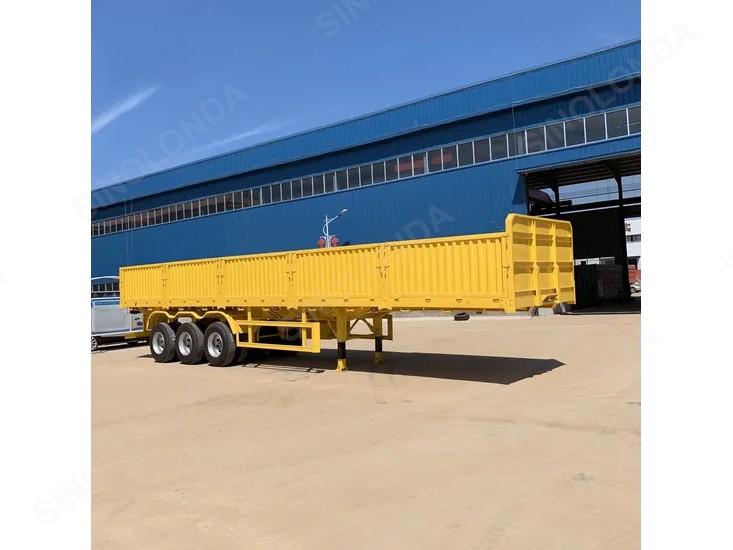
Architectural Logic & Sidewall Variants
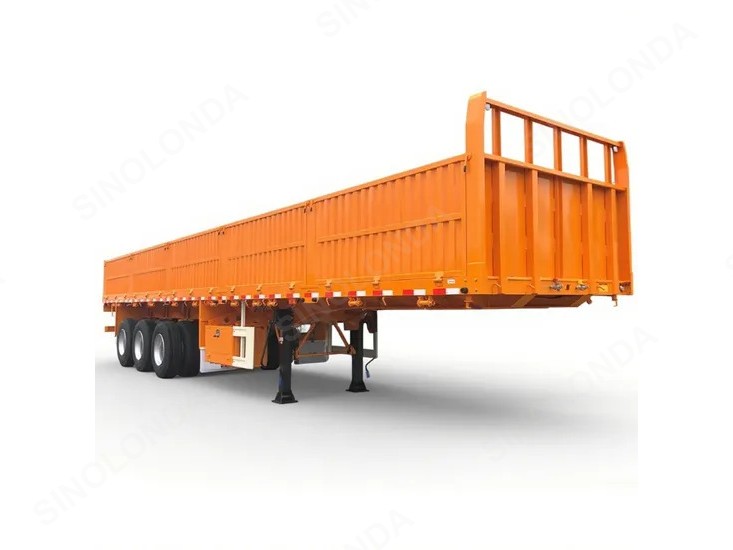
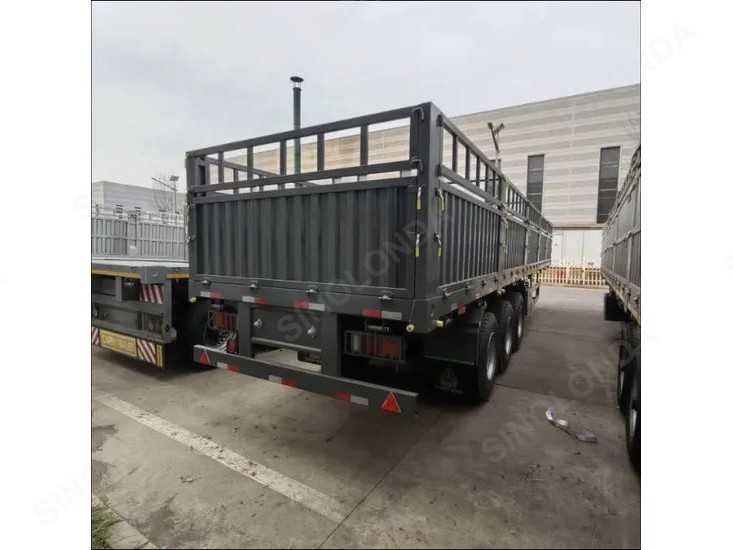
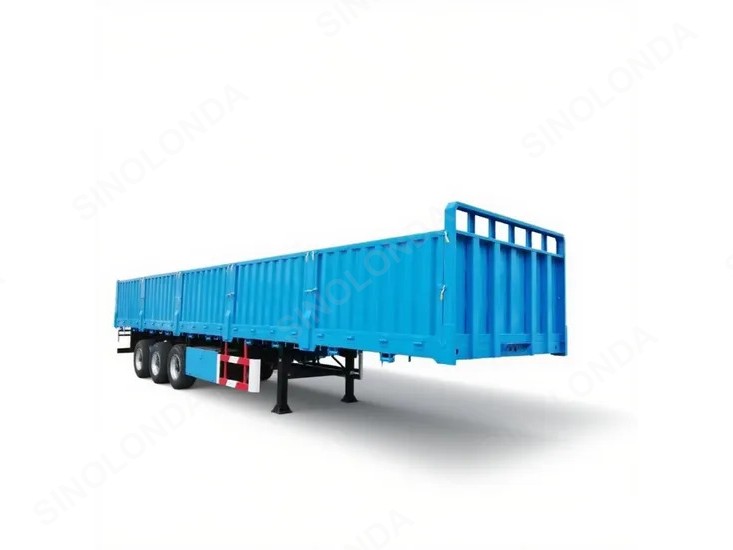
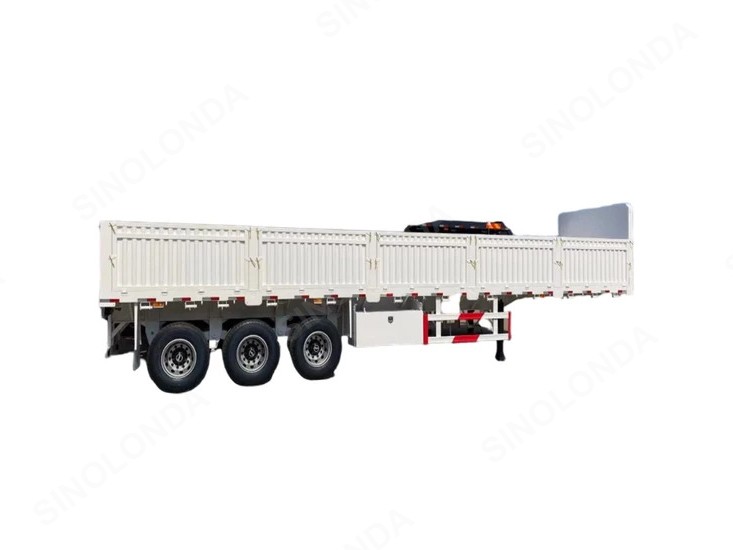
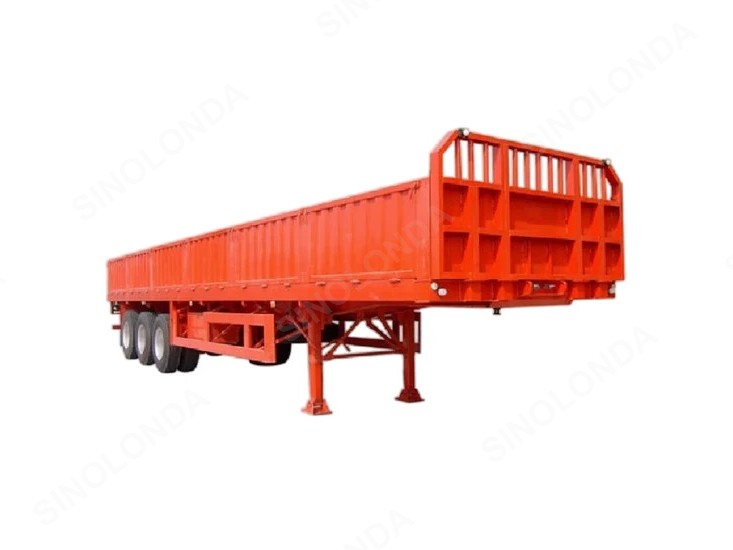
The sidewall trailer's value proposition is containment without enclosure. The side panels act as a lateral barrier, preventing cargo from shifting or falling off during cornering, braking, and road irregularities, but they do not carry the weather-protection or full structural-closure function of a box van. The panels are typically fixed, drop-down (foldable), or fully removable, and in many designs a single trailer can switch between configurations to suit the load.
Sidewall height is the primary variable. Common specifications range from 600 mm to 1,000 mm for general cargo containment, with 800 mm being a widely cited standard for export models. Taller configurations extend to 1,200 mm, 1,600 mm, or 2,200 mm for loose bulk commodities and light, voluminous freight. The double-layer drop-side arrangement—for example, 800 mm + 800 mm—allows the wall to be built up or reduced in stages, and in some designs a container can be carried without removing the dropped side wall. Front wall height is typically greater than the side walls—commonly 1,400 mm—to provide a forward bulkhead against load shift under braking.
A further configurational branch is the fence or stake-side variant, in which the side containment is formed by vertical posts and horizontal rails or planks rather than solid panels. This is favoured for agricultural and forestry loads where airflow and visibility are advantageous.
Structural & Running Gear Specifications
Chinese export sidewall trailers are predominantly built around Q345B high-strength low-alloy steel main beams, with a welded I-beam height of 500 mm and plate thicknesses consistently reported as 14 mm top flange, 8 mm web, and 16 mm bottom flange. The load deck is typically 3 mm checkered steel plate over cross-members, with the side panels in steel, aluminum, or composite depending on the tare-weight and durability priorities.
Axle configurations span two to four axles, most commonly three axles at 13 T or 16 T per axle from FUWA or equivalent brands, giving payload ratings in the 40–60 tonne band for 40-ft-class trailers. Tare weight for a tri-axle 40-ft sidewall trailer is commonly in the 8–10 tonne range, with heavier 60-tonne specifications around 9.1 tonnes. Suspension is typically mechanical leaf-spring (often a 10-leaf 90 mm × 13/16 mm pack), with air suspension available as an option. Kingpins are commonly 2-inch or 3.5-inch JOST units, and landing gear is rated at 28 tonnes.
A significant practical feature is optional twist-lock provision. Many sidewall models can be specified with 4, 8, or 12 container twist locks, allowing the trailer to carry one 40-ft or two 20-ft ISO containers in addition to general cargo—a configuration that blurs the line between sidewall and skeletal/chassis functionality.
Compliance & Load-Securing Standards
The sidewall trailer's structural obligations are most explicitly addressed in the European load-securing framework. EN 12642 stipulates that the side walls of commercial vehicle bodies with a permissible weight above 3.5 tonnes must be capable of resisting a lateral force equivalent to 30% of the payload (Code L), with Code XL raising the requirement to 40% and extending it to 75% of the side-wall height. This standard defines the sidewall not merely as a physical barrier but as a load-restraint element whose strength must be engineered and verified.
Export models frequently carry a layered certification profile: ISO 9001 for manufacturing quality, CE or ECE documentation for European-adjacent markets, DOT for North American alignment, CCC for the Chinese domestic market, and GCC for Gulf Cooperation Council countries. Where container-carrying capability is specified, the twist-lock and corner-fitting interfaces follow ISO 1161 dimensional and strength norms, and the trailer may be built to accommodate CSC-certified containers.
Operating Envelope & Applications
The sidewall trailer is the general-purpose containment platform of the semi-trailer family. Its natural cargo set spans construction materials (bagged cement, rebar, lumber, stone, precast concrete), agricultural products (grain, fertilizers, vegetables, fruit, straw, hay bales, livestock feed), bagged and palletized goods, and general freight that requires side containment but not full enclosure. It is equally at home in medium- and long-distance road haulage, construction logistics, agricultural supply chains, and port-to-inland distribution where the same trailer may need to carry a container on one leg and loose cargo on the next.