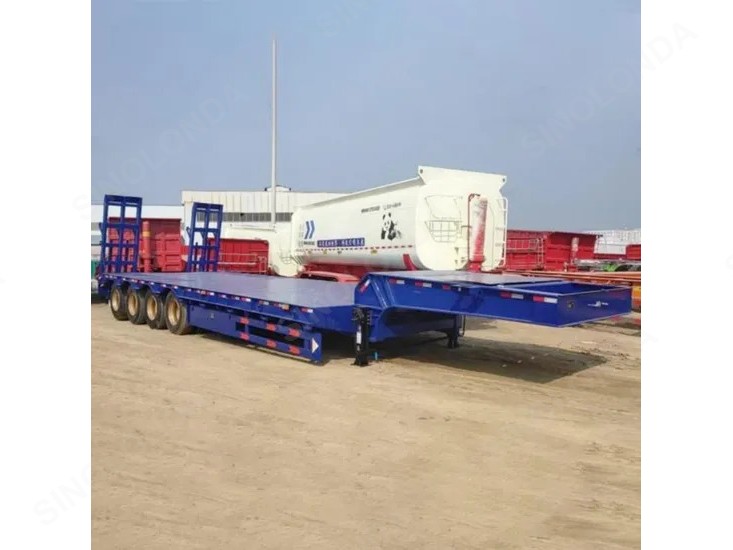
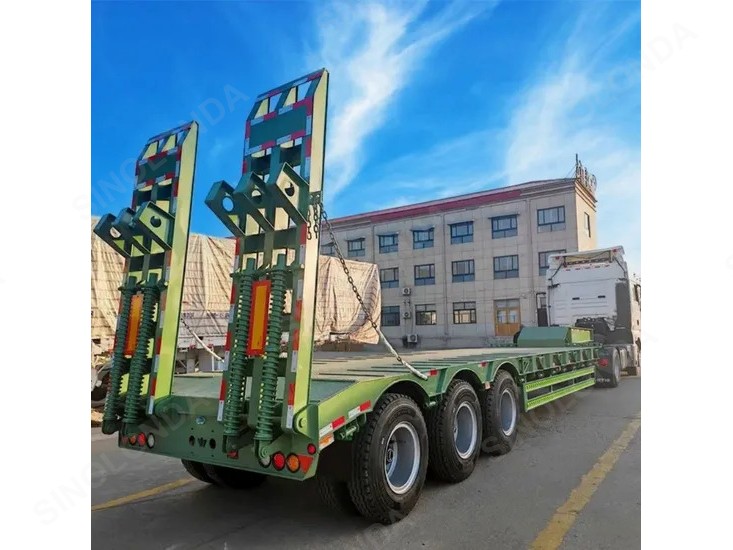
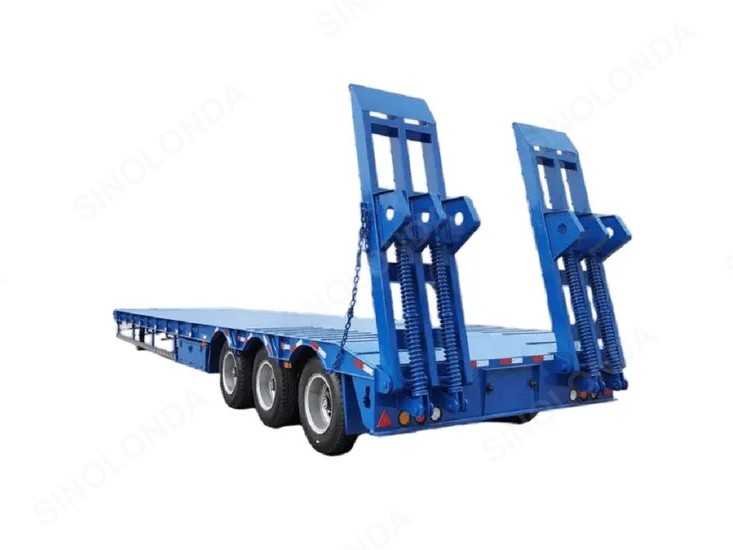
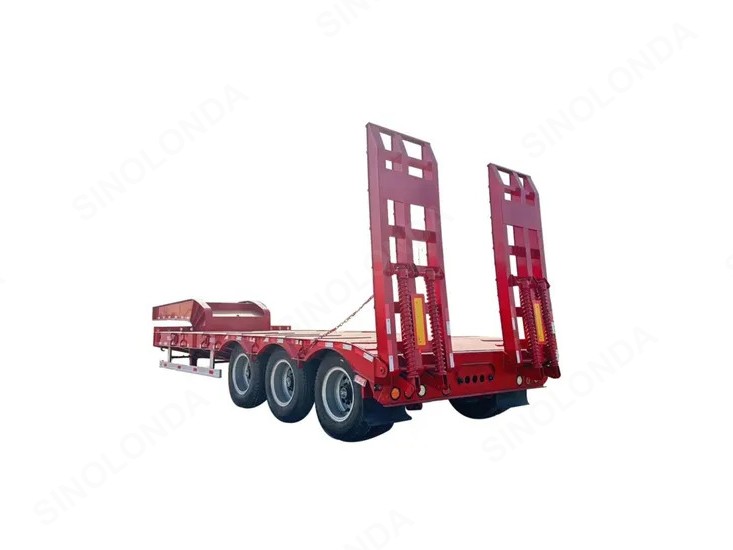
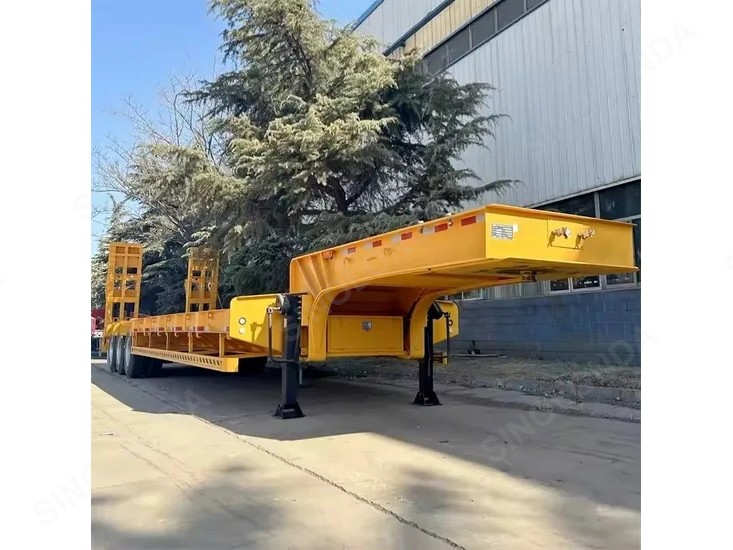
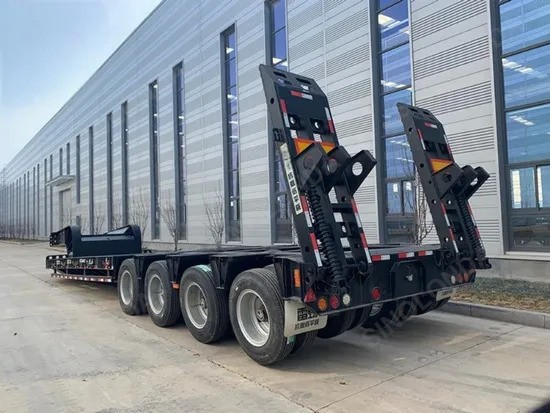
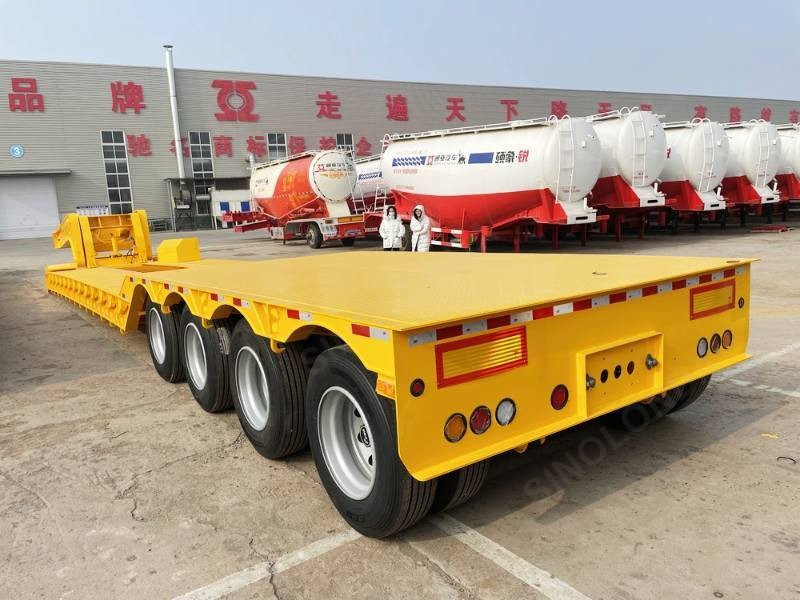
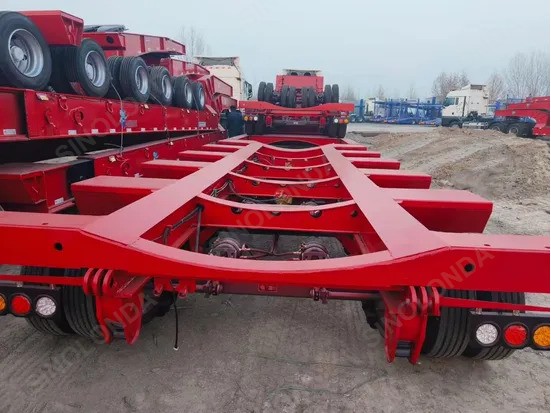
Gooseneck Architecture: The Defining Variable
The lowbed category subdivides almost entirely by how the gooseneck connects the tractor to the low deck, because this choice governs loading method, tare weight, and usable deck length.
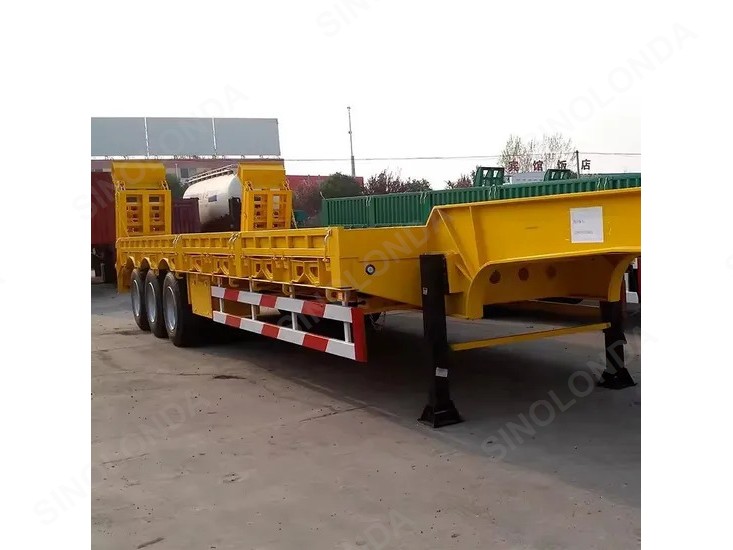
The fixed gooseneck (FGN) is the simplest and lightest configuration. The neck is permanently attached, the deck is the longest available within a given overall length, and loading is accomplished over rear ramps—mechanical spring ladders or hydraulic ramps. FGN units suit regular machinery haulage where equipment is self-propelled or can be winched up rear ramps.
The detachable gooseneck is the most consequential variant for heavy equipment. In a hydraulic detachable gooseneck (hydraulic RGN or HRGN) , large hydraulic cylinders release the neck from the deck, the tractor pulls away, and equipment is driven over the front directly onto the low deck without ramps. This is the fastest and most versatile configuration, but it adds weight and reduces achievable deck length compared with a fixed neck. A mechanically detachable gooseneck (mechanical RGN or MRGN) achieves the same front-loading capability with a lighter, simpler mechanism, trading away the speed and ease of hydraulic detachment.
The folding gooseneck takes a different approach: the neck folds down hydraulically to ground level, becoming its own ramp. This enables ramp-free loading without the detachment step, and is favoured where quick turnarounds matter more than maximum deck length or tare optimisation.
Beyond the gooseneck, multi-axle and extendable configurations stretch the platform's envelope. Axle counts run from 2 to 8 or more, with 4–8+ axle builds handling 100–300+ tonnes. Extendable decks adjust from roughly 40 to 80+ ft for long cargo such as wind blades or structural beams. A step-deck lowbed variant retains a two-level profile for mixed cargo that does not require the full depth of a double drop.
Structural & Running Gear Specifications
The lowbed's structural baseline follows the established export semi-trailer pattern but is calibrated for concentrated point loads and extreme bending moments. Chinese export specifications commonly use Q345B for the main I-beam, with a 500 mm beam height and plate thicknesses around 20 mm top flange / 12 mm web / 20 mm bottom flange on heavy-duty builds. T700 high-strength steel is offered as a lightweight alternative, reducing tare weight by approximately 1 tonne at equivalent capacity; Q460C (yield strength ≥620 MPa) and Q550/Q690 grades appear on higher-capacity and mining-oriented specifications.
Running gear scales with payload. A representative 3-axle export specification pairs 13 T or 16 T axles from BPW, FUWA, or equivalent with mechanical leaf-spring suspension (commonly a 10-leaf pack) and 28 T landing gear. Air suspension is available and becomes standard on European-style specifications, with axle lift on the first axle and self-steering on the last axle in more sophisticated builds. Kingpins are JOST 2-inch or 3.5-inch units, and braking follows a dual-line air system with ABS or EBS depending on the destination market.
Payload bands are commonly catalogued as follows: 2-axle units in the 30–40 tonne range; 3-axle at 40–60 tonnes; 4-axle at 60–80 tonnes; and multi-axle configurations from 80 tonnes upward to 300+ tonnes for modular and heavy-haul applications.
Hydraulic & Steering Systems
On detachable and folding gooseneck variants, the hydraulic system is a functional subsystem in its own right, controlling gooseneck detachment, deck height adjustment, ramp deployment, and—on multi-axle builds—steering response. Typical operating pressures in export and heavy-haul lowbed hydraulic systems fall in the 2,500–3,500 PSI range, with relief valves factory-set to the cylinder bore and load requirements. The gooseneck cylinders are often powered by a self-contained hydraulic pump station on the trailer, driven by a small engine or the tractor's auxiliary circuit, so that detachment does not depend on a specialised wet-kit on every tractor.
For very heavy or long combinations, hydraulic steering axles become essential. Systems such as TRIDEC Tritronic provide remote-controlled steering on multiple axles, with electronic alignment and independent hydraulic circuits for steering and gooseneck compensation. A 55° maximum turning angle on the first steering axle and all-wheel hydraulic traction or control steering are cited on modular heavy-haul configurations.
Operating Envelope & Applications
The lowbed's natural cargo set is heavy, tall, and indivisible: construction equipment (excavators, bulldozers, cranes, graders), mining and oilfield machinery (drilling rigs, fracking equipment), energy-sector components (wind-turbine nacelles and blades, transformers), military and government loads (tanks, missile launchers), and industrial modules such as prefabricated plant sections. Its operational habitats are construction and infrastructure project sites, mining and energy logistics corridors, port-to-project heavy-haul routes, and defence movements.