Discharge Architecture & Type Differentiation
The dump trailer category subdivides by where the material exits the body, and this geometric choice determines almost every operational trade-off.
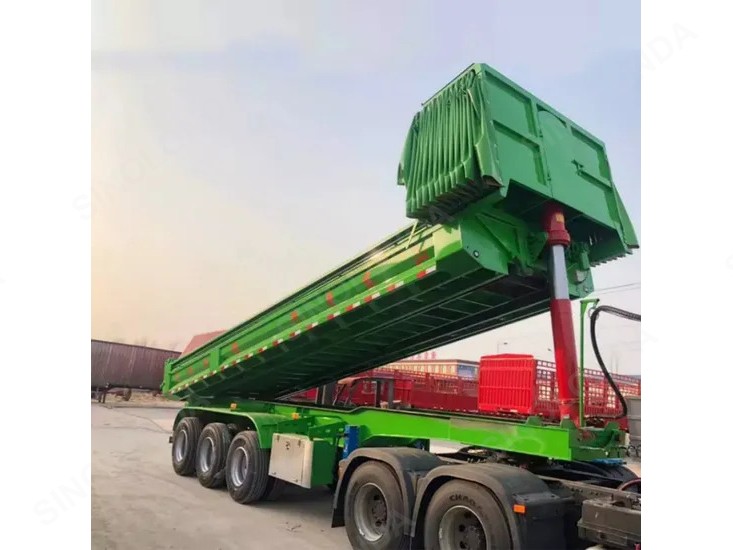
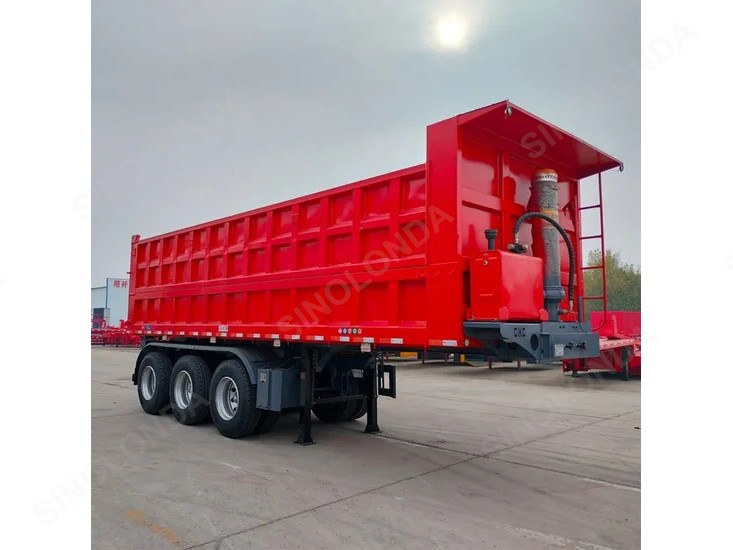
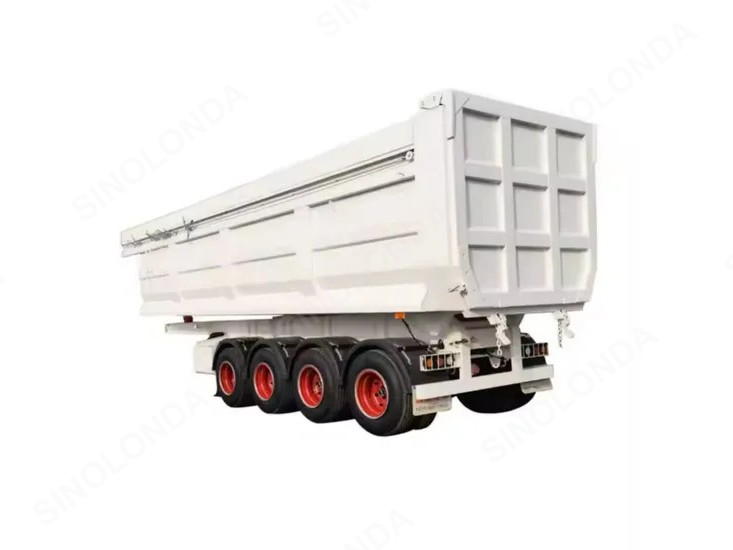
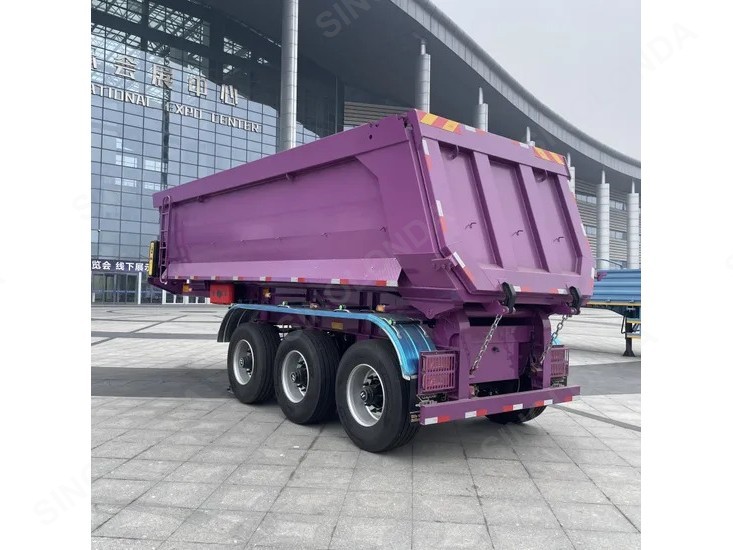
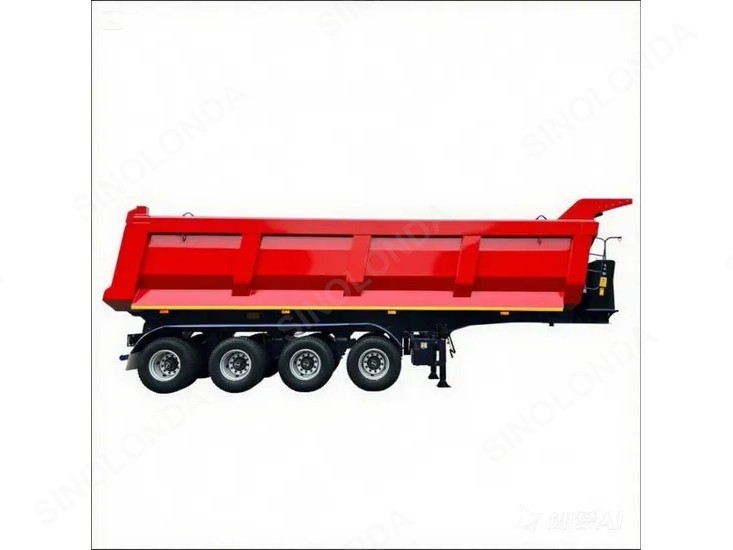
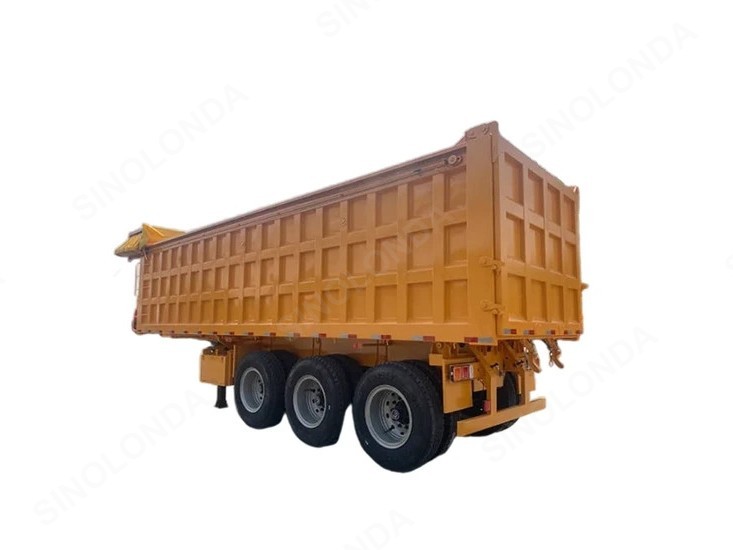
The rear dump (end dump) lifts the front of the body around rear hinges, discharging through a tailgate. It is the highest-volume variant and the one most readily identified with the "dump semi-trailer" name. Rear dumps typically have higher sides than the other two types, giving them greater cubic capacity for a given footprint and making them the preferred choice for aggregate stockpiling, demolition debris, and rough materials where volume and payload matter more than placement precision. The central trade-off is stability: a raised rear-dump body has a high centre of gravity, and the trailer can become unstable if the unloading surface is not level or if the load shifts in transit. Rear dumps are also poorly suited to semi-liquid loads, because the tailgate is difficult to seal against leakage.
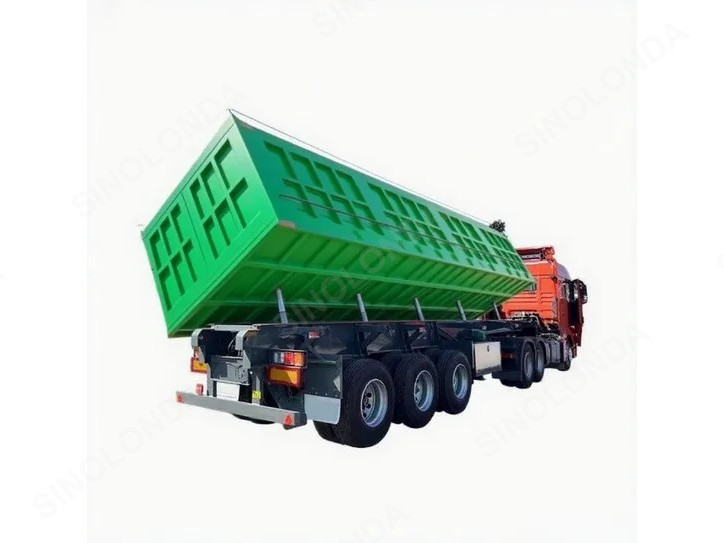
The side dump rotates the body laterally on one side, discharging along the trailer's length rather than out the back. Its operational advantage is stability on soft or uneven ground: the side dump does not require a level backing area, and the discharge geometry keeps the centre of gravity lower than a fully raised rear dump. This makes side dumps effective for road-building base placement, rail ballast distribution, and mining overburden, where material must be laid in a controlled line rather than stockpiled in one spot. The costs are smaller cubic capacity for a comparable axle configuration and limited manoeuvrability in confined unloading areas. A side dump also requires the receiving site to have lateral clearance on the discharge side—it cannot unload against a wall or in a tight bay.
The bottom dump (belly dump) does not raise the entire body at all. A clamshell gate or sliding floor on the underside releases material directly beneath the trailer, allowing the unit to windrow—lay a continuous line of aggregate as it drives forward through the discharge zone. This is the architecture of choice for free-flowing aggregate, where controlled placement in a roadbed or trench is the objective rather than stockpiling. The body remains level throughout discharge, giving it the lowest stability risk of the three types, but it is functionally limited to materials that flow reliably through a bottom gate and cannot handle cohesive, frozen, or oversized loads.
Hydraulic Tipping System
The functional core of the dump trailer is its hydraulic lifting system. A power take-off (PTO) on the tractor typically drives a hydraulic pump; the pump supplies oil flow, resistance to movement generates pressure, and that pressure acting on the cylinder's effective area produces the lifting force. Flow governs lifting speed; pressure and cylinder area govern force, and the two are engineered together rather than independently.
Structural & Running Gear Specifications
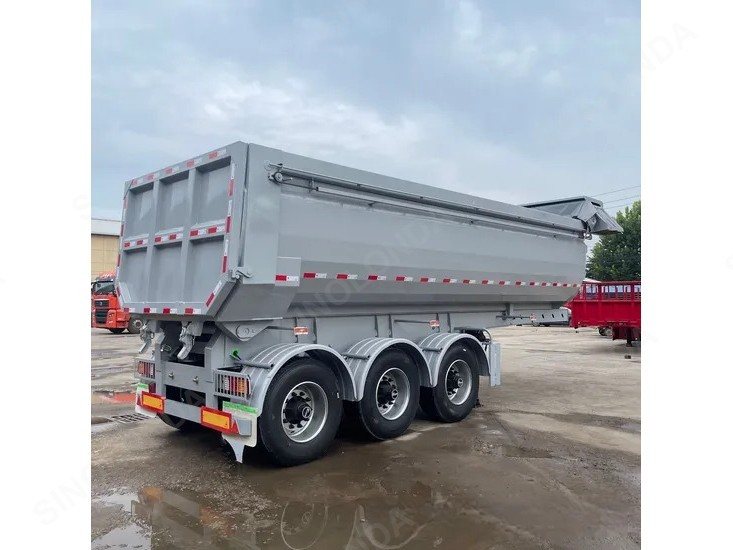
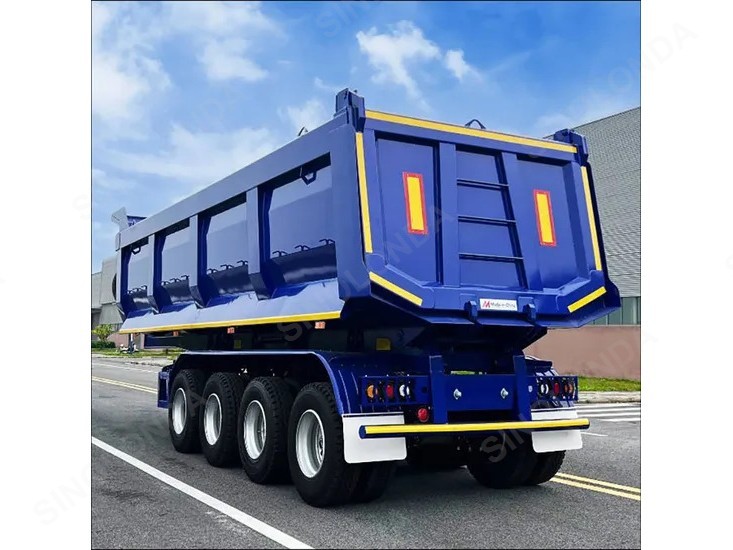
The load body is where dump trailers diverge most sharply from other semi-trailer types. Typical Chinese export specifications use Q345B high-strength steel for the main beams, with a 500 mm I-beam and plate thicknesses of 14 mm top flange, 8 mm web, and 16 mm bottom flange—the same chassis baseline seen across the flatbed and sidewall families. The body itself, however, is built for abrasion and impact: cargo box floors are commonly 8–10 mm, side walls 3–8 mm, and premium specifications use Hardox 450 or NM450 wear-resistant plate in the body and discharge zone. U-shaped bodies are frequently specified as an alternative to rectangular boxes, promoting more complete material discharge and reducing retention at the corners.
Running gear follows the established export pattern: 2, 3, or 4 axles at 13 T or 16 T per axle from FUWA or BPW, with mechanical leaf-spring suspension (typically a 90 mm × 13 mm × 10-layer pack) as standard and air suspension optional. Tare weight scales with axle count and body specification: 2-axle units commonly fall in the 7–8 tonne band with 20–30 tonne payloads; 3-axle units around 8–10 tonnes tare with 30–50 tonne payloads; and 4-axle heavy-duty configurations reach 10–14 tonnes tare with 50–70 tonne payloads, with some export catalogues citing up to 100 tonnes for specialised mining builds. Kingpins are JOST 2-inch or 3.5-inch units, landing gear is rated at 28 tonnes, and braking follows a dual-line air system with T30/30 chambers and optional ABS.